July 7, 2026Milford Mills Tile TeamKitchen Tile13 min read
Kitchen Floor Tile: Chester County PA Homeowners Guide
Share
Quick Summary
Kitchen floor tile in Chester County PA is one of the highest-ROI flooring investments you can make — but material selection, substrate preparation, and professional installation quality determine whether the result lasts 30 years or needs replacing in five. This guide covers the best tile materials for Chester County kitchens, how the installation process works, realistic cost ranges for 2026, and the design decisions that separate great results from average ones.
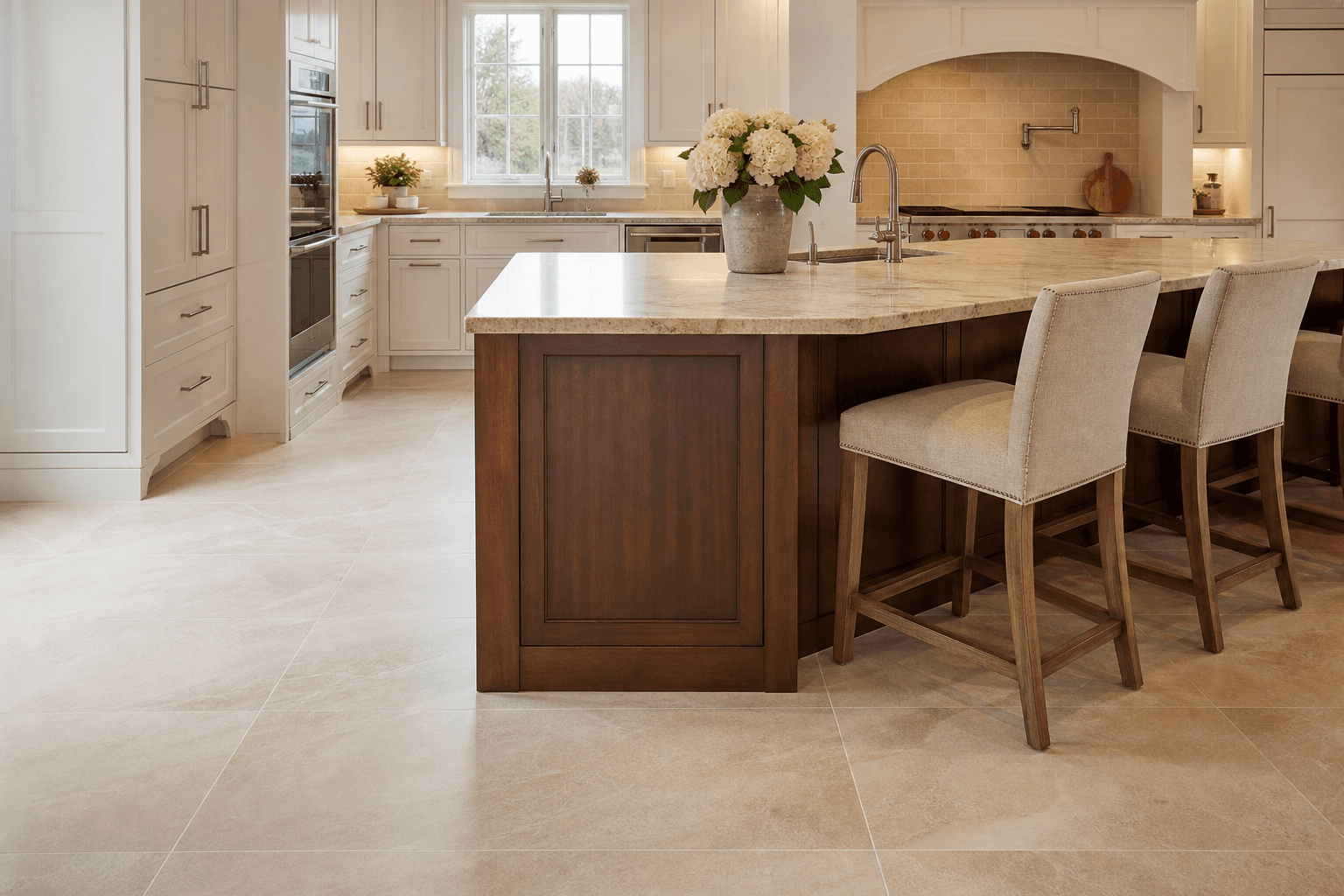
Your kitchen floor takes more punishment than any other surface in your home. Daily foot traffic, dropped items, spilled liquids, tracked dirt, and years of cooking activity demand a material built to hold up — and look good doing it. Kitchen floor tile Chester County PA homeowners select is one of the most consequential renovation decisions in any home. With Chester County properties ranging from 1890s stone colonials to mid-century split-levels to new construction, the right tile depends on your specific structure, lifestyle, and design priorities.
Milford Mills Tile has installed kitchen floors throughout Chester County, Delaware County, Montgomery County, and the Main Line for over 20 years. Our team is Wedi Certified and Schluter Certified, and we’ve completed more than 1,000 projects across the region. Here’s what that experience tells us about making a kitchen floor tile project succeed.
Why Kitchen Floor Tile Is the Right Choice for Chester County Homes
Chester County homeowners consistently choose tile for kitchen floors over hardwood, luxury vinyl, or laminate — and the reasons are practical, not just aesthetic.
Durability. Properly installed porcelain or ceramic tile in a kitchen will outlast every other flooring material. It doesn’t dent, warp, fade, or delaminate under kitchen conditions. A 20-year-old tile floor looks and performs identically to a new one if it was installed correctly and maintained properly.
Moisture resistance. Kitchens produce moisture from steam, splashes, spills, and floor washing. Tile — unlike hardwood — is impervious to moisture when installed with the right substrate and grout sealer. Chester County’s older homes, where subfloor moisture from basements or seasonal humidity can be a factor, benefit especially from tile’s non-absorptive properties.
Resale value. Main Line and Chester County buyers recognize quality tile immediately. A well-executed kitchen floor tile job signals craftsmanship and durability throughout the home. Updated kitchen floors are among the top features that shorten days-on-market in this market.
Design flexibility. No flooring material offers the range of sizes, colors, textures, and patterns that tile does. Whether you’re finishing a farmhouse kitchen in Unionville or a sleek open-concept space in Devon, there’s a tile approach that works.
Best Tile Materials for Kitchen Floor Tile Chester County PA Kitchens
The right material depends on your kitchen’s traffic level, your design goals, and your home’s subfloor conditions. Here’s how the major options stack up in Chester County kitchens.
Porcelain (Large Format)
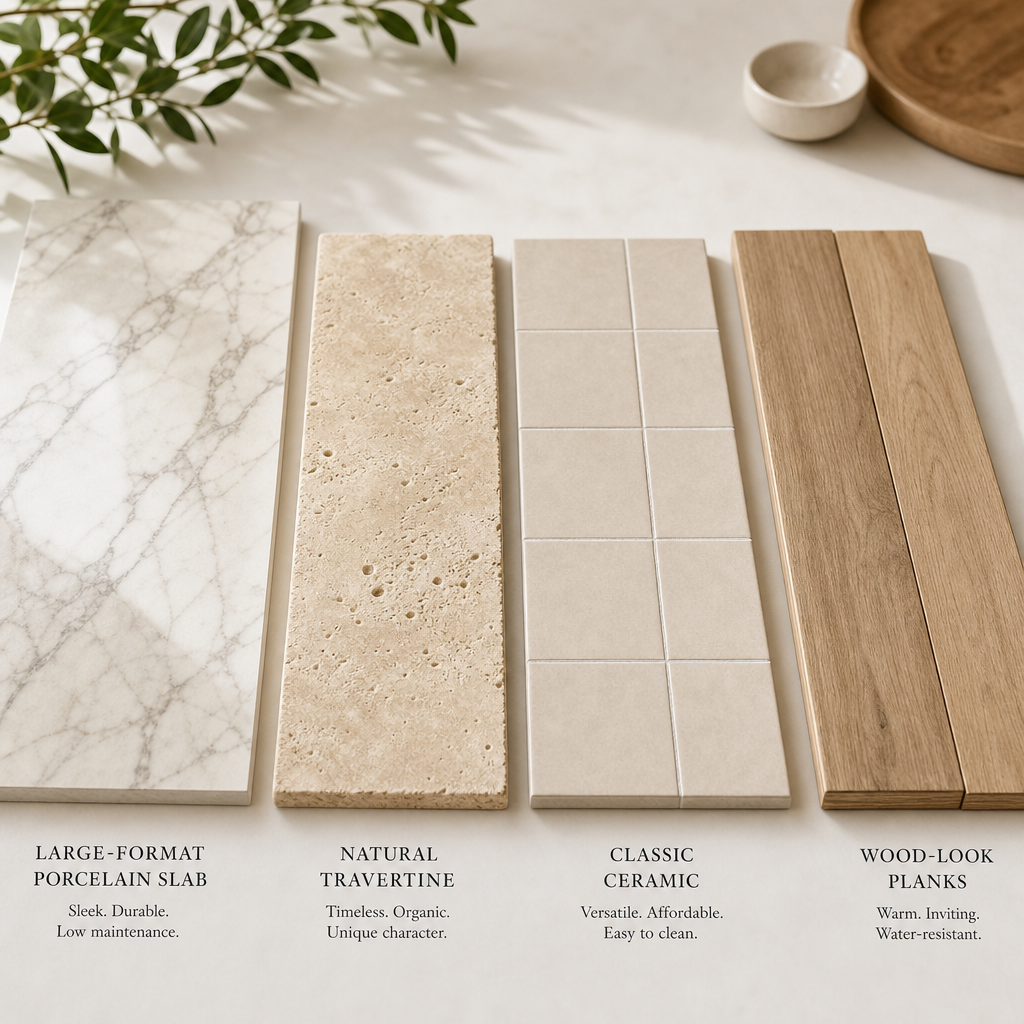
Porcelain is the dominant kitchen floor tile choice in Chester County right now — and for good reason. It’s hard, dense, virtually impervious to moisture, and available in a huge range of formats and finishes. Large-format porcelain (24×24, 12×24 planks, or 24×48 slabs) creates a seamless, uncluttered kitchen floor with fewer grout lines to clean.
The challenge: large-format porcelain requires a very flat substrate — within ⅛” over 10 feet. Older Chester County homes often have subfloors that don’t meet this standard without leveling work, which is why the substrate preparation phase is so critical. An experienced installer identifies these issues before a tile goes down, not after.
Best for: Most Chester County kitchens, particularly those undergoing a full renovation where substrate prep can be done properly. Open-plan kitchens where consistent flooring runs through dining and living areas benefit especially from large-format porcelain.
Ceramic (Mid-Size Format)
Ceramic tile — typically 12×12 or 12×24 — remains a solid choice for Chester County kitchens where budget is a primary consideration. It’s lighter than porcelain, easier to cut, and performs well in moderate-traffic kitchens. The trade-off: ceramic is slightly more porous than porcelain and less resistant to heavy impact. For a family kitchen with young children or pets, porcelain’s density is usually worth the additional investment.
Natural Stone (Travertine, Slate, Limestone)
Natural stone kitchen floors are common in Chester County’s older, more traditional homes — particularly properties with colonial or European farmhouse aesthetics where the warmth of travertine or slate fits the architecture. Stone is beautiful and adds genuine character that manufactured tile can’t replicate.
The honest tradeoffs: natural stone is porous and must be sealed before use and annually thereafter. Some stones — travertine especially — have natural voids that collect grease and debris if left unfilled. Polished stone is slippery when wet. For an active kitchen, choose a honed or tumbled finish with good traction properties, and work with an installer who understands stone-specific setting materials.
Wood-Look Porcelain Planks
If you want the visual warmth of hardwood in your kitchen without hardwood’s moisture vulnerability, wood-look porcelain planks deliver it convincingly. Modern printing technology has advanced to the point where even experienced contractors do a double-take in the right light. These planks — typically 6×36 or 8×48 — run beautifully through open-plan spaces where the kitchen flows into a hardwood great room, creating visual continuity without the moisture risk at the kitchen transition.
The main material categories for Chester County kitchen floors — large-format porcelain, natural stone, standard ceramic, and wood-look porcelain plank — each suited to different budgets, aesthetics, and subfloor conditions.
100+ Five-Star Reviews
Get a Free Tile Quote
20+ years installing bathroom, kitchen, and custom tile across Chester, Delaware & Montgomery counties, PA.
Choosing the Right Size and Layout for Your Kitchen
Tile size and layout pattern affect how your kitchen reads — its apparent size, proportions, and visual character. Here’s what to know before you commit.
Large Format vs. Standard Format
Large-format tile (anything over 15″ in either dimension) makes a kitchen feel bigger and more seamless. It’s particularly effective in smaller Chester County kitchens — under 150 square feet — where minimizing grout lines visually expands the space. Standard format (12×12 or 12×24) is more forgiving of subfloor imperfections and easier to work around obstacles like island footings and door thresholds.
Layout Pattern
The layout pattern affects both appearance and installation complexity:
Straight lay. Tiles run parallel to walls in a grid pattern. Classic, easy to install, and the most forgiving of variations in tile size. Works with any format.
Offset (brick pattern). Each tile is staggered — typically one-third or one-half offset. More dynamic than straight lay. Note: for tile longer than 15″, a one-third offset is typically specified to minimize lippage; avoid 50% offset with large format tile.
Diagonal (45°). Tiles run at 45° to the walls. Makes rooms feel larger and is visually striking. Requires more cuts and generates more waste — budget 15% overage instead of 10%.
Herringbone. Planks interlocked at 90° angles in a zigzag pattern. Works especially well with wood-look porcelain and long format tiles. More labor-intensive and slower to install, which affects total project cost.
Grout Line Width
Rectified porcelain can be installed with joints as tight as 1/16″. Most Chester County kitchen installations use 1/8″ to 3/16″ joints. Grout color is a significant design decision: matching grout minimizes the visual pattern; contrasting grout emphasizes it. For kitchens, lighter grout reads cleaner aesthetically — sealed epoxy grout addresses the maintenance concern if staining is a worry.
What Kitchen Floor Tile Installation Looks Like
A professional kitchen floor tile installation follows a set sequence. Cutting corners on any phase creates problems that compound over time.
Phase 1: Demo and Substrate Assessment
Existing flooring is removed and the subfloor is evaluated. In Chester County’s older homes, this often reveals layers of historic flooring — linoleum over vinyl over an original wood subfloor. The subfloor must be structurally sound (no bounce or deflection), clean, and flat before any tile prep begins. Floor joists in pre-1960 construction sometimes need bridging or sistering to eliminate flex.
Phase 2: Substrate Preparation
Depending on conditions, we install Schluter Ditra uncoupling membrane or cement backer board as the tile substrate. Ditra is our default for kitchens — it decouples the tile from the subfloor, allowing each to move independently with temperature and humidity changes without transmitting stress to the grout or tile. This is especially valuable in Chester County’s four-season climate, where basements and crawl spaces can cause significant seasonal moisture movement in subfloors.
Self-leveling compound is applied as needed to bring the substrate within ⅛” flatness over 10 feet — required for large-format tile.
Phase 3: Layout Planning
We determine the starting point for the tile layout based on the room’s most prominent sight lines — typically from the kitchen entry or through the doorway from the main living space. A dry-run layout catches problems: awkward slivers at walls, a pattern that starts off-center on the island, or tile that doesn’t divide evenly into the space. We adjust the starting point to minimize cuts in high-visibility areas.
Phase 4: Setting
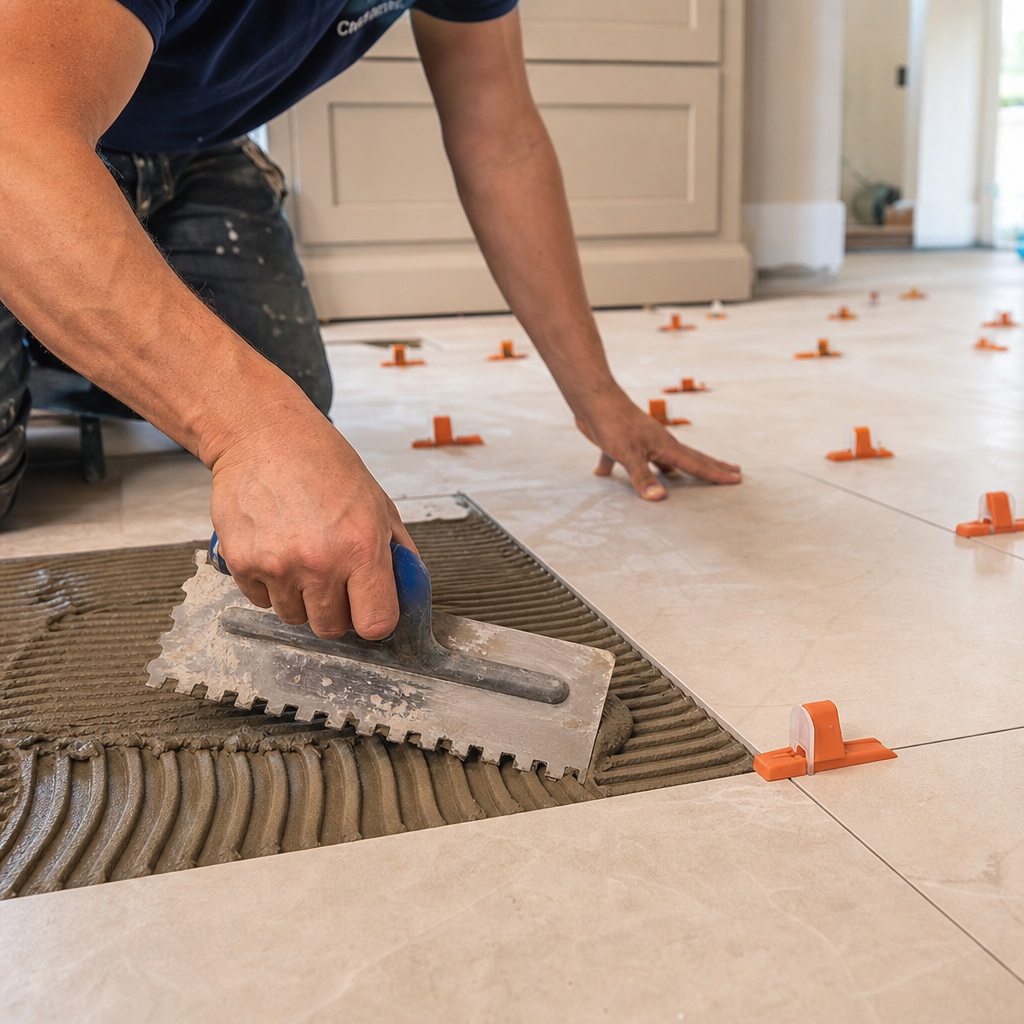
Tiles are set in polymer-modified thinset mortar appropriate for the tile type and format. For large-format porcelain, we back-butter every tile to achieve 95%+ mortar coverage — the TCNA standard for kitchen floor applications. Leveling clips and wedges eliminate lippage through the setting process. In a typical Chester County kitchen of 150–200 square feet, the setting phase takes 1–2 full days.
Phase 5: Grouting and Sealing
After a 24-hour set time, we apply grout. For kitchen floors, we typically use sanded cement grout for joints over 3/16″ and unsanded for tighter joints — epoxy grout for clients who want maximum stain resistance. All grout in kitchen applications is sealed after the cure period. We recommend resealing annually for natural stone and every 2–3 years for sealed cement grout.
Phase 6: Transitions and Trim
Where the kitchen tile meets adjacent flooring — hardwood in a dining room, carpet in a mudroom, tile in a foyer — Schluter transition profiles create clean, durable edges. The right profile (height, finish, width) depends on the height differential and adjacent materials. These details matter aesthetically and prevent the chipping and cracking that happens at unprotected tile edges.
Setting large-format porcelain kitchen floor tile with leveling clips and polymer-modified thinset — standard practice for Chester County kitchen installations.
Kitchen Floor Tile Cost in Chester County PA
Direct answer: a professionally installed kitchen floor tile job in Chester County typically runs $2,500 to $9,000+ for a standard 150–200 square foot kitchen, depending on tile selection, substrate conditions, and project complexity.
Tile Material Costs
Standard ceramic (12×12): $2–$5/sq ft
Mid-range porcelain: $5–$12/sq ft
Premium large-format porcelain or wood-look plank: $10–$25/sq ft
Natural stone (travertine, slate, limestone): $12–$45+/sq ft
Purchase 10% overage for standard layouts, 15% for diagonal or herringbone patterns.
Labor Costs
Professional tile installation in Chester County runs $12–$22 per square foot for straightforward applications and $18–$30+ for complex formats, patterns, or difficult substrate conditions. A 175 sq ft kitchen floor might require 15–25 hours of skilled labor across demo, prep, setting, grouting, and trim.
Substrate and Prep
Schluter Ditra membrane, self-leveling compound, and subfloor repairs are additional and vary by existing conditions. Budget $500–$2,000 for substrate work in a typical Chester County kitchen — potentially more in homes with significant historic layering or structural concerns.
What Drives Cost Up
Large-format tile (requires extra leveling work)
Herringbone or diagonal patterns (more cuts, more labor)
Historic homes with multiple flooring layers (more demo)
Island or peninsula obstacles that require additional cuts
Natural stone (requires different mortar, more care in setting)
Ready to get an accurate number for your kitchen? Request a no-obligation quote — we provide detailed, itemized estimates after seeing your specific space.
Design Ideas for Chester County Kitchen Floors
Chester County homes span a wide range of architectural styles, and the right kitchen floor tile approach differs by home type. Here are the combinations we see working consistently in this region.
Chester County Farmhouse and Colonial Homes
Warm-toned tile reads authentically in traditional Chester County homes. Options: 12×24 porcelain in a warm cream or sand tone with tight grout lines, natural travertine in a honed finish, or large-format slate. Avoid cool-toned grey tile — it can read as incongruent in homes with warm wood millwork and antique hardware.
Main Line Open-Plan Kitchens
In the open-plan layouts common in Wayne, Berwyn, and Ardmore, large-format porcelain in a neutral — warm white, light taupe, or concrete grey — creates visual flow from kitchen through dining and living. A 24×24 or 24×48 format in a straight lay minimizes visual breaks and makes the combined space feel unified. See how we’ve approached similar kitchen tile projects in Chester County for design context.
Contemporary Chester County Builds
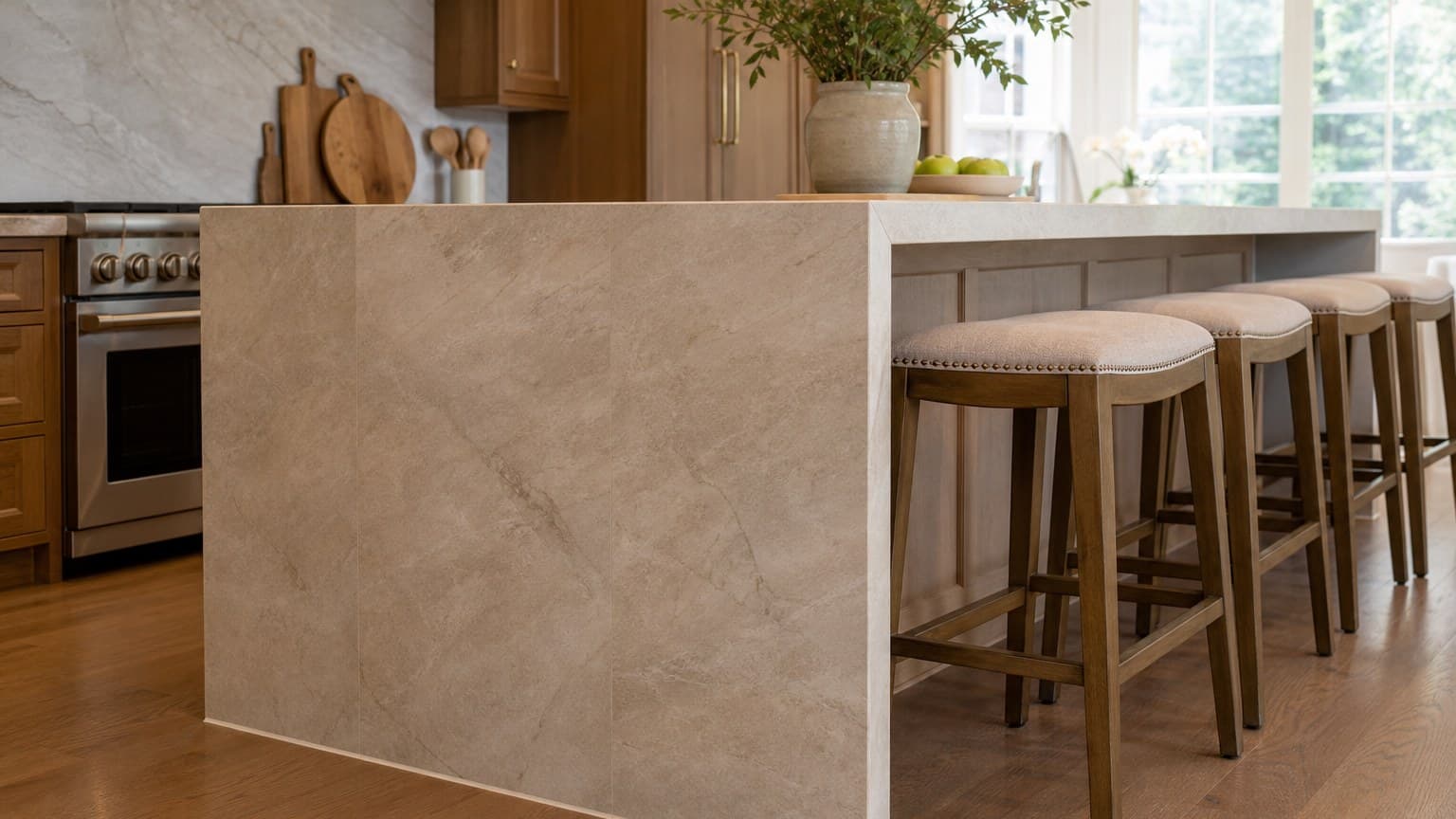
Modern homes with flat-front cabinetry, quartz counters, and minimal molding benefit from large-format porcelain in high-contrast finishes — 24×48 charcoal tile with thin white grout, or full-slab porcelain panels that eliminate grout lines entirely. The substrate precision requirements for these formats are exacting, which is why this work requires an experienced installer.
Transitional Kitchens
The most common Chester County kitchen style — transitional — blends traditional architecture with contemporary finishes. 12×24 planks in a light warm tone, wood-look porcelain in a herringbone or straight lay, or a classic white hexagon mosaic floor all read well. These approaches pair naturally with our broader Chester County tile installation services.
Frequently Asked Questions
How long does kitchen floor tile installation take?
A standard 150–200 square foot kitchen floor tile installation takes 3–5 working days from start to finish: demo and substrate prep (1–2 days), tile setting (1–2 days), grouting and sealing (1 day), and trim/transitions (partial day). Add 1–2 days for complex layouts like herringbone, significant substrate leveling work, or large-format tile on uneven subfloors. The kitchen is minimally functional during installation, but you’ll want to stay off the tile for 24 hours after setting and avoid water exposure in grouted areas for 72 hours after grout application.
Can you tile over an existing kitchen floor?
Sometimes, yes — but with conditions. The existing floor must be solidly bonded (no hollow spots or loose tiles), structurally sound (no bounce or deflection), and flat within ⅛” over 10 feet. Adding tile raises the floor height by ¼”–½”, which can create issues at appliance thresholds, door clearances, and adjacent flooring transitions. In Chester County’s older homes, where existing floors often include historic layers of vinyl, linoleum, or old ceramic, we generally recommend demo and a fresh start to ensure a proper substrate. We evaluate every project individually before making a recommendation.
What tile is best for a kitchen floor with pets and children?
Porcelain is the most durable and practical choice for active Chester County households with pets and children. It’s scratch-resistant, stain-resistant, and impervious to moisture. Choose a matte or textured finish rather than a polished one — polished floors show paw prints, footprints, and every water drip. Medium-toned grout (not pure white) hides everyday dirt between cleanings. Epoxy grout is the maximum stain-resistance option. Avoid natural stone in this use case — the porosity and sealing requirements are difficult to maintain in a high-traffic household.
Does kitchen tile add value to my Chester County home?
Yes, consistently. Kitchen renovations are among the highest-ROI improvements in Chester County real estate, and flooring is one of the most visible elements buyers evaluate. Well-executed tile installation signals quality and durability — the opposite of sheet vinyl or worn laminate. In the Main Line and Chester County market, where buyers expect high-quality finishes, a professionally installed tile floor can meaningfully affect how quickly your home sells and at what price. We’ve worked with homeowners specifically timing a kitchen floor project before listing.
Do you serve all of Chester County PA?
Yes. Milford Mills Tile serves all of Chester County — West Chester, Malvern, Berwyn, Wayne, Downingtown, Kennett Square, Coatesville, Phoenixville, Exton, and the surrounding communities — as well as Delaware County, Montgomery County, and the Main Line. We have over 20 years of experience and more than 1,000 completed tile projects throughout the region.
Ready to Transform Your Chester County Kitchen Floor?
Get a detailed, no-obligation estimate from Milford Mills Tile — Wedi Certified and Schluter Certified installers with 20+ years of experience serving Chester County, Delaware County, and Montgomery County PA.