July 14, 2026Milford Mills Tile TeamOutdoor & Specialty Spaces12 min read
Sunroom Tile Installation in Chester County PA Homes
Share
Quick Summary
Sunroom tile installation in Chester County PA requires flooring engineered for the unique demands of glass-enclosed spaces — wide seasonal temperature swings, direct UV exposure, and the humidity cycles that PA’s four-season climate delivers. Porcelain tile installed over a Schluter Ditra uncoupling membrane is the definitive solution for Chester County sunrooms. This guide covers the best materials, correct substrate approach, realistic costs, and design ideas that work in this region’s homes.
Your sunroom or four-season room sits at the boundary between indoor living and outdoor exposure. It collects more sun, experiences wider temperature swings, and handles more traffic between the garden and the house than any other room. Sunroom tile installation Chester County PA homeowners choose has to perform under conditions that standard interior flooring simply doesn’t face: a sunroom in a Wayne or Malvern colonial can swing from 25°F in January to 100°F+ on a July afternoon with the sun coming through the glass. That thermal range — and the structural movement it creates — is what makes material selection and proper installation so consequential.
Milford Mills Tile has installed sunroom and four-season room floors throughout Chester County, the Main Line, Delaware County, and Montgomery County for over 20 years. We’re Wedi Certified and Schluter Certified, and more than 1,000 projects have given us a detailed picture of what works and what fails in Chester County’s specific climate conditions. Here’s what that experience tells us.
Why Tile Is the Right Choice for Chester County Sunrooms
Chester County homeowners have tried other flooring options in sunrooms — hardwood, luxury vinyl plank, laminate, carpet — and the ones who call us are almost always replacing them with tile. Here’s why tile outperforms every alternative in glass-enclosed rooms.
Thermal stability. The temperature in a Chester County sunroom swings far wider than the rest of the house. On a sunny winter day, a glass-enclosed room can reach 70°F while the outside is 20°F. In July, an afternoon sun can push a four-season room past 95°F. Wood expands and contracts with these swings; vinyl plank can buckle or soften; laminate degrades with humidity and heat cycles. Tile — installed with the right uncoupling system — handles these conditions for decades.
UV resistance. Direct, sustained sunlight fades most flooring materials noticeably within a few years. Porcelain tile is fired at over 2,000°F — UV exposure doesn’t change its color. Natural stone, properly sealed, holds up similarly. This matters enormously in a room designed to capture sunlight.
Moisture management. Chester County summers are humid, and sunrooms condense moisture on cool mornings when the glass is cold and the room warms up. That condensation cycle affects subfloors and flooring materials over time. Tile’s imperviousness to moisture — combined with a properly waterproofed substrate — eliminates this failure mode entirely.
Transition to the outdoors. Sunrooms typically open directly to a patio, garden, or pool deck. Tile works as a seamless transition between indoor and outdoor spaces in a way that wood or vinyl never can. We can extend the same tile material or a complementary tile from the sunroom straight onto a covered patio, creating visual continuity — see how we’ve approached similar outdoor tile projects in Chester County for examples.
Durability and cleanliness. Gardens and sunrooms create a constant flow of soil, mulch, and moisture into the home. Tile is the easiest surface to clean and the most resistant to the grit and debris that comes with outdoor living.
Best Materials for Sunroom Tile Installation Chester County PA Homes
The right tile material for a Chester County sunroom depends on your aesthetic priorities, how the room connects to outdoor spaces, and your home’s subfloor conditions. Here’s how the main options perform in this specific application.
Porcelain (Large Format)
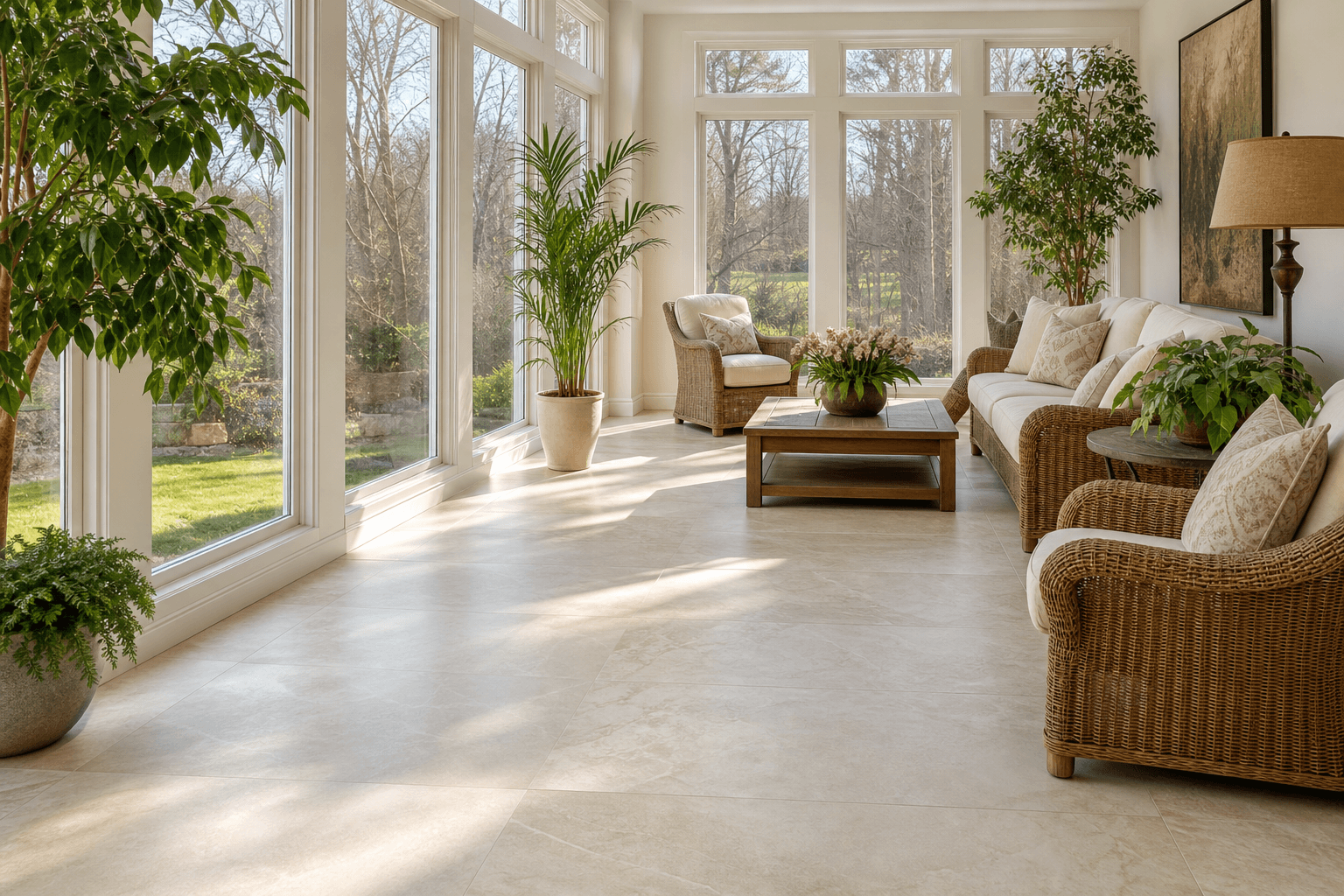
Porcelain is the dominant choice for Chester County sunrooms — and for good reason. It’s hard, dense, UV-stable, and impervious to moisture. Large-format porcelain (24×24, 12×24 planks, or 24×48 slabs) creates a clean, expansive look with minimal grout lines, making a sunroom feel larger and more open. Light-toned porcelain in a matte or lightly textured finish reflects sunlight beautifully without the glare of polished surfaces.
For Chester County sunrooms specifically, a frost-rated porcelain — one rated for freeze-thaw cycles — is the right specification even for enclosed rooms. Sunrooms that aren’t heated through the winter can drop to near-freezing; frost-rated tile handles this without risk of surface cracking or spalling.
Best for: Most Chester County sunrooms. Especially effective in contemporary and transitional rooms where a clean, seamless floor is the goal.
Ceramic
Ceramic tile is a budget-conscious option for Chester County sunrooms with moderate temperature ranges — rooms that are heated and cooled year-round and don’t experience sub-freezing temperatures. Ceramic is lighter than porcelain and easier to cut, but it’s more porous and more susceptible to moisture penetration and UV fading over time. For an actively conditioned four-season room in a newer Chester County home, ceramic works well. For an older room that gets cold in winter or faces intense summer sun without air conditioning, porcelain is the better investment.
Natural Stone (Travertine, Slate, Limestone)
Natural stone floors in Chester County sunrooms — particularly travertine and slate — deliver a warmth and character that no manufactured tile replicates. In traditional Chester County homes where the sunroom opens onto a garden, stone floor tile creates a natural, organic aesthetic that connects the interior to the landscape outside.
The honest tradeoffs: stone is porous and must be sealed before use and annually thereafter. Travertine specifically has natural voids that require filling before installation in high-traffic spaces. Polished stone is slippery when wet. For a Chester County sunroom, choose a honed or brushed finish for traction, use a penetrating stone sealer annually, and ensure your installer understands stone-specific setting materials and grout requirements. Done correctly, a natural stone sunroom floor is extraordinary.
Wood-Look Porcelain Planks
Wood-look porcelain planks are one of the most popular choices for Chester County sunrooms right now — homeowners want the warmth of hardwood in a sun-exposed room without hardwood’s vulnerability to UV fading, moisture, and thermal movement. Today’s wood-look porcelain (typically 6×36 or 8×48 planks) achieves a convincing visual result in warm oak, ash, or walnut tones. It runs beautifully from a sunroom into adjacent hardwood areas, creating visual continuity. And unlike real hardwood, it will look identical in 20 years.
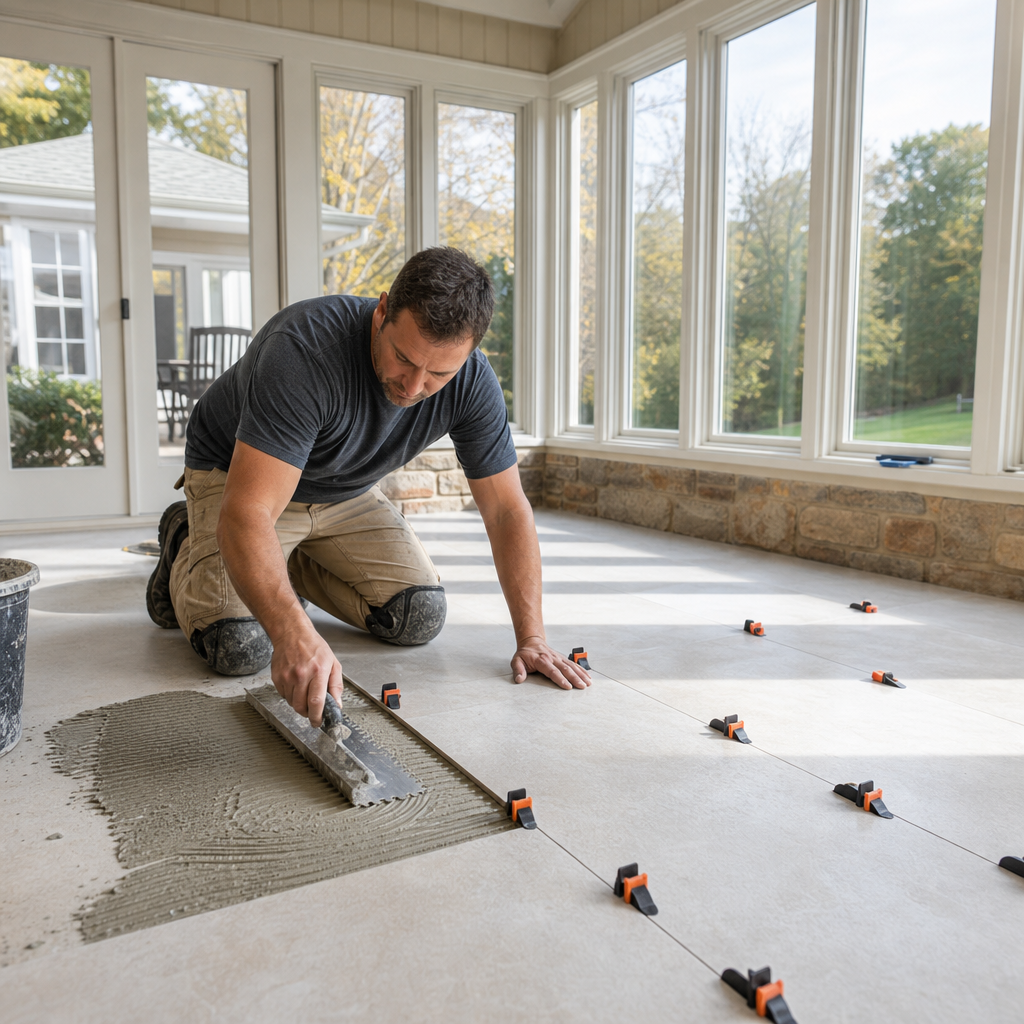
Setting large-format porcelain in a Chester County PA sunroom using a Schluter Ditra uncoupling membrane and leveling clip system — the correct substrate approach for the region’s thermal cycling.
100+ Five-Star Reviews
Get a Free Tile Quote
20+ years installing bathroom, kitchen, and custom tile across Chester, Delaware & Montgomery counties, PA.
This is where most sunroom tile failures originate. A sunroom floor is not the same as an interior floor, and the substrate system has to reflect that.
The Thermal Movement Problem
In any building, structural elements move with temperature and humidity changes. In a sunroom — where a wood subfloor or concrete slab is exposed to significant thermal cycling year-round — this movement is amplified. If tile is bonded rigidly to a subfloor that’s moving beneath it, the stress concentrates at the grout joints and the tile edges. Eventually, grout cracks, tiles debond, or — in severe cases — tiles crack through.
Schluter Ditra Uncoupling Membrane
The solution for wood-subfloor Chester County sunrooms is a Schluter Ditra uncoupling membrane between the subfloor and the tile. Ditra allows the subfloor and the tile layer to move independently, absorbing the stress of thermal cycling instead of transmitting it to the tile and grout. It also waterproofs the subfloor surface and provides a reliable setting bed for the thinset. We specify Ditra as standard for virtually every Chester County sunroom installation on a wood-frame floor.
Concrete Slab Sunrooms
Some Chester County sunrooms are built on concrete slabs rather than wood-frame floors — common in ranch-style additions or basement-level sunrooms. Concrete requires different treatment: the slab must be assessed for moisture vapor transmission (concrete wicks moisture from the ground, which can debond thinset over time), and a vapor-suppressing primer or membrane is applied before tile installation. Schluter’s Ditra-XL works well over concrete for its combination of uncoupling and vapor management.
Radiant Floor Heating
Tile and radiant heat are natural partners — tile’s thermal conductivity makes it the best flooring surface for in-floor heating systems. If a radiant heat system is being added to a Chester County sunroom tile installation, the heating element is embedded in the thinset layer between the uncoupling membrane and the tile surface. This must be coordinated before installation begins: the thermostat and heating mat are positioned during substrate prep, not as an afterthought after the tile is set. Radiant heat is a popular upgrade in Chester County sunrooms used year-round.
Choosing Size, Layout, and Pattern for Your Sunroom
Sunrooms have a visual character that benefits from specific tile decisions — the right choices make a modest sunroom feel like an expansive retreat; the wrong ones make it feel busy and cramped.
Tile Format
Large-format tile — anything over 15″ in either dimension — is well-suited to sunrooms. Fewer grout lines create a cleaner, more open visual field, and the consistency of large porcelain slabs reads particularly well in bright, sun-filled rooms. For sunrooms under 150 square feet, a 12×24 plank or a 24×24 square creates visual expansion without looking oversized. For larger rooms, 24×48 or full-slab porcelain formats work beautifully and nearly eliminate the grout line entirely.
Layout Direction
In most sunrooms, tile should run toward the primary view — the garden, pool, or outdoor area the room is designed to frame. Running planks or large-format tiles perpendicular to the view pulls the eye outward, making the room feel like a natural continuation of the landscape. Diagonal tile layouts (45° to walls) are another strong option for sunrooms: they make the room feel larger and more dynamic, and they don’t require as strict an alignment to the room’s primary axis.
Grout Selection
In a sun-filled room, grout color is amplified — light grout reflects more light and reads clean; dark grout creates a grid that emphasizes the tile pattern. For most Chester County sunrooms, we recommend a slightly warm-neutral grout that neither disappears nor dominates. Use epoxy grout for maximum durability and stain resistance in rooms that transition to outdoor spaces. For large-format porcelain with tight joints (1/16″ to 1/8″), an unsanded, polymer-modified grout is the correct specification.
What Sunroom Tile Installation Looks Like
A properly executed sunroom tile installation follows a specific sequence. The substrate phase is more involved than a typical interior floor, which is why sunroom projects take slightly longer than comparable square-footage bathroom or kitchen jobs.
Phase 1: Assessment and Demo
We evaluate the existing subfloor for structural integrity, moisture conditions, flatness, and thermal history. Existing flooring is removed. In Chester County’s older homes, sunroom floors sometimes have surprising layers — original slate over vinyl over a wood subfloor, or a concrete slab pour-over that’s raised the floor height significantly. Demo clarifies what we’re working with before any prep begins.
Phase 2: Substrate Preparation
For wood-frame sunrooms, Schluter Ditra or Ditra-XL uncoupling membrane is installed over the subfloor, bonded with unmodified thinset. Radiant heat elements are positioned at this stage if applicable. Self-leveling compound is applied as needed to bring the surface within ⅛″ flatness over 10 feet — the standard for large-format tile. This phase often takes a full day in Chester County sunrooms with older, uneven subfloors.
Phase 3: Layout Planning
We establish the starting point based on the room’s primary sight lines — typically the view from the interior house door looking toward the garden. A dry-run layout identifies any awkward cuts at walls, centering issues at the door threshold, or pattern problems at the transition to adjacent flooring. Getting this right before the first tile is set prevents costly corrections later.
Phase 4: Setting
Tiles are set in polymer-modified thinset mortar appropriate for the tile type and format. Large-format porcelain requires back-buttering (applying thinset to the back of each tile) to achieve 95%+ mortar coverage — the TCNA standard. Leveling clips and wedges are used throughout to eliminate lippage. A typical 150–200 square foot Chester County sunroom floor takes 1–2 days to set.
Phase 5: Grouting and Sealing
After a 24-hour cure, grout is applied and finished. Natural stone and porous ceramic receive a penetrating sealer after grout cure. Schluter transition profiles are installed at every threshold — the door to the interior, the door to the patio or deck, and any height differential between the sunroom floor and an adjacent surface. These transitions are critical for both function and aesthetics at an indoor-outdoor boundary.
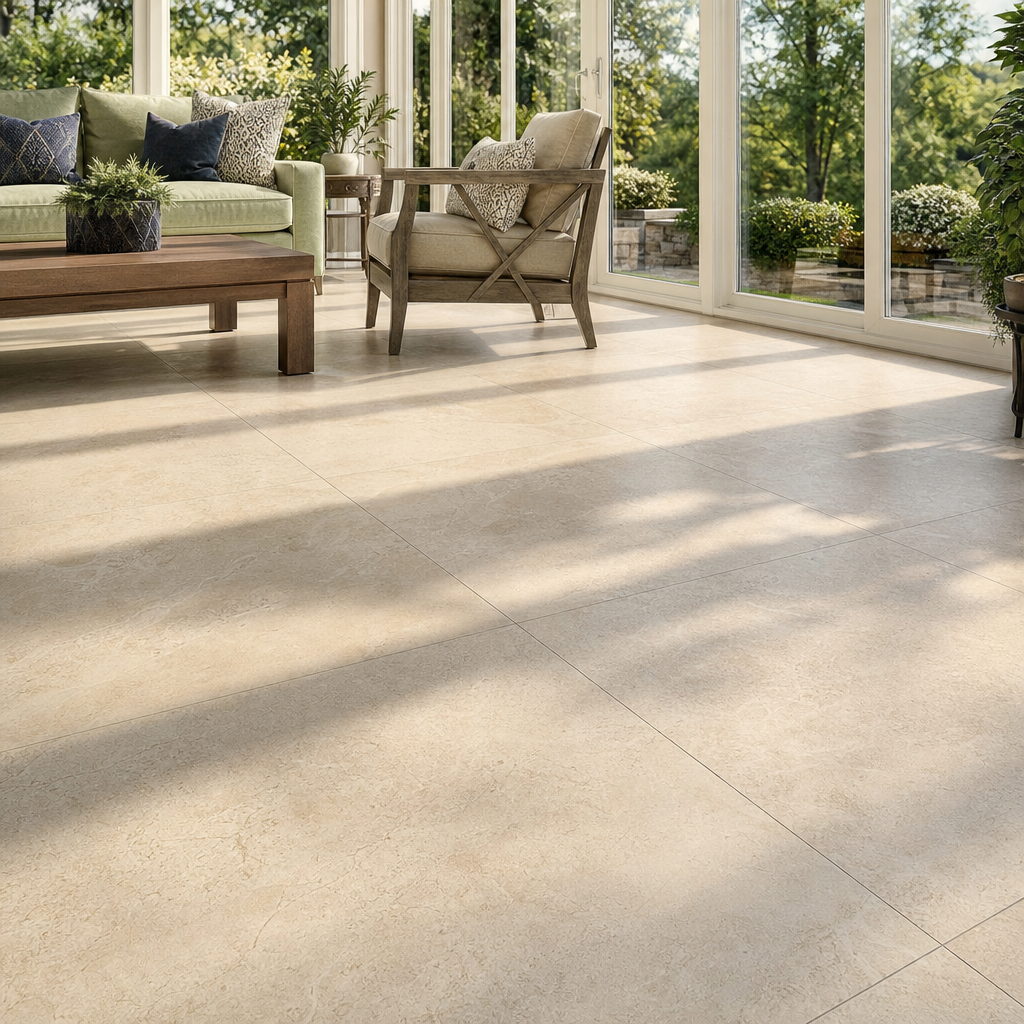
A completed sunroom tile installation in Chester County PA — large-format porcelain in warm cream tones with tight grout lines, warm afternoon light, and a Schluter transition profile at the patio threshold.
Sunroom Tile Installation Cost in Chester County PA
A professionally installed sunroom tile floor in Chester County typically runs $3,000 to $10,000+ for a standard 150–200 square foot room, depending on tile selection, substrate complexity, and any additional work like radiant heat or threshold transitions to outdoor spaces.
Tile Material Costs
Standard ceramic: $2–$5/sq ft
Mid-range porcelain: $5–$12/sq ft
Large-format or wood-look porcelain: $10–$25/sq ft
Natural stone (travertine, slate): $12–$40+/sq ft
Labor Costs
Professional tile installation in Chester County sunrooms runs $14–$24 per square foot for standard applications and $20–$35+ for complex substrate conditions, large-format tile, or diagonal layouts. Sunrooms carry a modest labor premium over interior rooms because of the Ditra membrane requirement and more complex transitions.
Substrate and Additional Costs
Schluter Ditra membrane: $3–$5/sq ft installed
Radiant heating system: $8–$15/sq ft installed (mat plus thermostat)
Self-leveling compound: $500–$1,500 depending on condition
Schluter transition profiles: $50–$200 per threshold
What Drives Cost Up
Significant subfloor issues — common in Chester County’s older sunroom additions
Large-format tile (exacting flatness requirements, back-buttering every piece)
Diagonal layout (more cuts, more waste material — budget 15% overage)
Natural stone with filling and sealing requirements
Radiant heat integration
Multiple threshold transitions (interior floor, patio door, step down to garden)
For an accurate number specific to your room, request a no-obligation estimate — we provide detailed, itemized quotes after seeing the space and assessing the subfloor.
Design Ideas for Chester County Sunrooms
Chester County’s residential architecture ranges from 18th-century stone farmhouses to mid-century ranches to contemporary new construction. The right sunroom tile approach differs meaningfully by home style.
Traditional Chester County and Main Line Homes
In Wayne, Haverford, Berwyn, and Paoli — where traditional colonial and Tudor architecture dominates — sunrooms typically have warm, natural aesthetics. Large-format porcelain in a warm cream or limestone tone, a honed travertine, or a slate tile in charcoal reads authentically in these interiors. Avoid overly cool or industrial grey tones; they can feel incongruent with the warm millwork and stone architecture typical of Main Line properties.
Chester County Farmhouse and Rural Properties
In Unionville, Kennett Square, and the rural parts of Chester County, sunrooms often serve as working garden rooms — spaces for potting plants, storing tools, and transitioning from muddy outdoor activity to the main house. Here, a durable, easy-to-clean porcelain in an earthy tone — slate-look, stone-look, or a simple cream field tile — does the job practically and aesthetically. Dark grout colors hide dirt and debris better than light grout in these working sunrooms.
Contemporary Chester County New Construction
Modern homes in Exton, Malvern, and newer West Chester developments have clean-lined sunrooms that benefit from large-format porcelain in a contemporary palette — warm white, light concrete grey, or a sophisticated dark charcoal. 24×48 porcelain slabs with near-invisible grout lines create a seamless look that connects the sunroom visually to the rest of the open-plan interior. Paired with a frameless glass door and a porcelain patio extension, the result is a truly seamless indoor-outdoor space.
The Indoor-Outdoor Transition
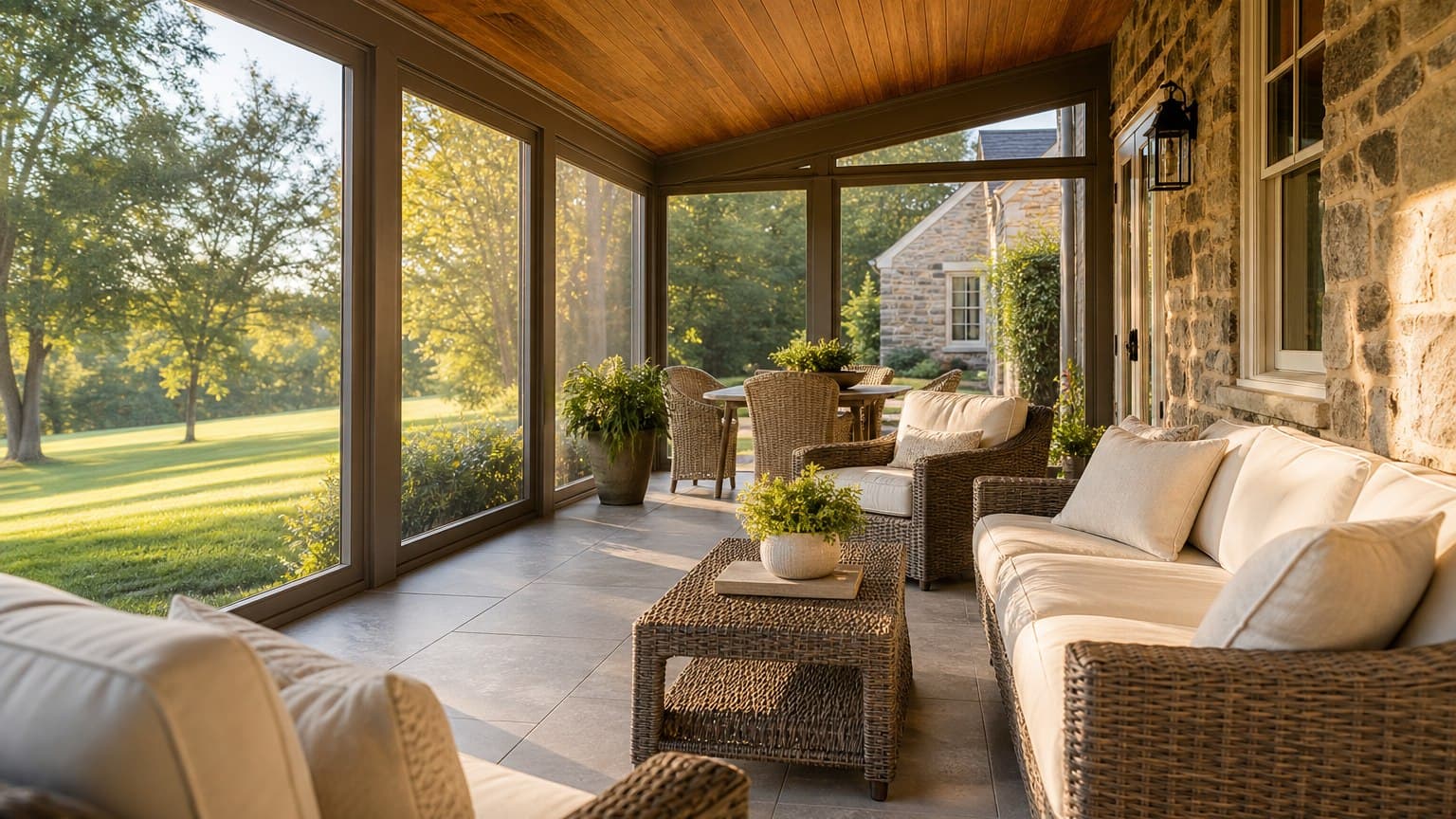
One of the most successful design moves in Chester County sunrooms is using the same tile — or a closely matched tile — from the sunroom floor onto a covered patio or deck extension. This visual continuity blurs the line between inside and outside and maximizes the sense of space in both areas. Use frost-rated tile for any exterior applications, and ensure the threshold transition is properly detailed with a Schluter profile to handle the height differential and protect the tile edges. See our complete guide to Chester County tile installation services for more design and project examples from our work in this region.
Frequently Asked Questions
What is the best tile for a sunroom floor in Chester County PA?
Frost-rated porcelain tile is the best choice for most Chester County sunrooms — it handles the wide temperature swings common in glass-enclosed rooms, resists UV fading, and is impervious to moisture. Large-format porcelain (24×24 or 12×24) creates a clean, seamless look with minimal maintenance. For a warmer aesthetic, wood-look porcelain planks are a close second. Natural stone (travertine, slate) is beautiful but requires annual sealing and more careful maintenance. The critical factor in all cases is the substrate: a Schluter Ditra uncoupling membrane beneath the tile is essential for Chester County’s thermal cycling conditions.
Do I need special tile for a sunroom because of temperature swings?
Yes. If your Chester County sunroom is not conditioned (heated and cooled) year-round, or if it drops near freezing in winter, you need frost-rated tile — typically specified as porcelain with a water absorption rate under 0.5%. This rating indicates the tile can withstand freeze-thaw cycles without cracking or spalling. Most quality porcelain tiles sold today meet this specification, but it’s worth confirming with your installer. Beyond tile selection, the substrate is equally critical: a Schluter Ditra uncoupling membrane allows the subfloor and tile to move independently through seasonal temperature changes, preventing the grout cracking and tile debonding that is the most common failure in sunroom tile installations.
How much does sunroom tile installation cost in Chester County PA?
A professionally installed sunroom tile floor in Chester County typically runs $3,000 to $10,000+ for a standard 150–200 square foot room. The range depends on tile selection (ceramic vs. premium large-format porcelain vs. natural stone), substrate complexity (simple flat subfloor vs. uneven additions requiring leveling), and any additions like radiant heat or multiple threshold transitions to adjacent flooring or outdoor spaces. Sunroom tile installation carries a modest labor premium over interior rooms because of the Ditra membrane and the specialized transition work at patio doors and interior thresholds. Request a detailed estimate after an in-person subfloor assessment for an accurate number.
Can you add radiant floor heating under sunroom tile?
Yes, and it’s one of the most popular upgrades in Chester County sunroom tile projects. Tile is the ideal surface for in-floor radiant heat — its thermal conductivity transfers heat efficiently and evenly across the room. The heating element (a low-profile electric mat or hydronic tubing, depending on the system) is embedded in the thinset layer between the uncoupling membrane and the tile. This work must be coordinated before tile installation begins, not added afterward. A thermostat with a floor temperature sensor is installed at the wall. In a Chester County sunroom, radiant heat extends usable months well into fall and early spring without the visual intrusion of radiators or forced-air registers.
How long does sunroom tile installation take?
A typical 150–200 square foot Chester County sunroom tile installation takes 4–6 working days from start to finish: demo and subfloor assessment (1 day), Ditra membrane and substrate preparation (1–2 days), tile setting (1–2 days), grouting and sealing (1 day), and transitions and trim (partial day). Add 1–2 days for complex substrate conditions, a diagonal layout, or large-format tile on an uneven sunroom addition floor. The room is out of use during installation and for 24 hours after setting; stay off grouted areas for 72 hours after grout application.
Ready to Transform Your Chester County Sunroom?
Get a detailed, no-obligation estimate from Milford Mills Tile — Wedi Certified and Schluter Certified installers with 20+ years of experience serving Chester County, Delaware County, and Montgomery County PA.