November 24, 2026Milford Mills Tile TeamMaintenance, Repair & Value7 min read
Thinset vs Mortar: What to Know
Share
Quick Summary
Thinset is a type of mortar: TCNA calls it a blend of cement, very finely graded sand and a water retention compound, used in a thin layer.
Modified thinset has polymers added; TCNA lists freeze/thaw resistance, improved flexibility and improved adhesion as commonly cited benefits.
TCNA says to use the adhesive recommended for the tile, the substrate and the location, and that thinset is not for adjusting the level or flatness of a surface.
Ask your installer which setting material they will use and why, which standard it meets and how the surface and coverage will be checked.
Thinset vs mortar sounds like a choice between two products, but thinset is a type of mortar. It bonds tile to the surface underneath in a thin layer. If you are planning bathroom tile or a new floor, here is what the terms mean and what to ask your installer.
Thinset vs mortar: what is the difference?
Thinset is mortar. The Tile Council of North America (TCNA) says that thinset mortar is "a blend of cement, very finely graded sand, and a water retention compound," and that the terms thinset cement, thinset mortar, dryset mortar and drybond mortar are synonymous.
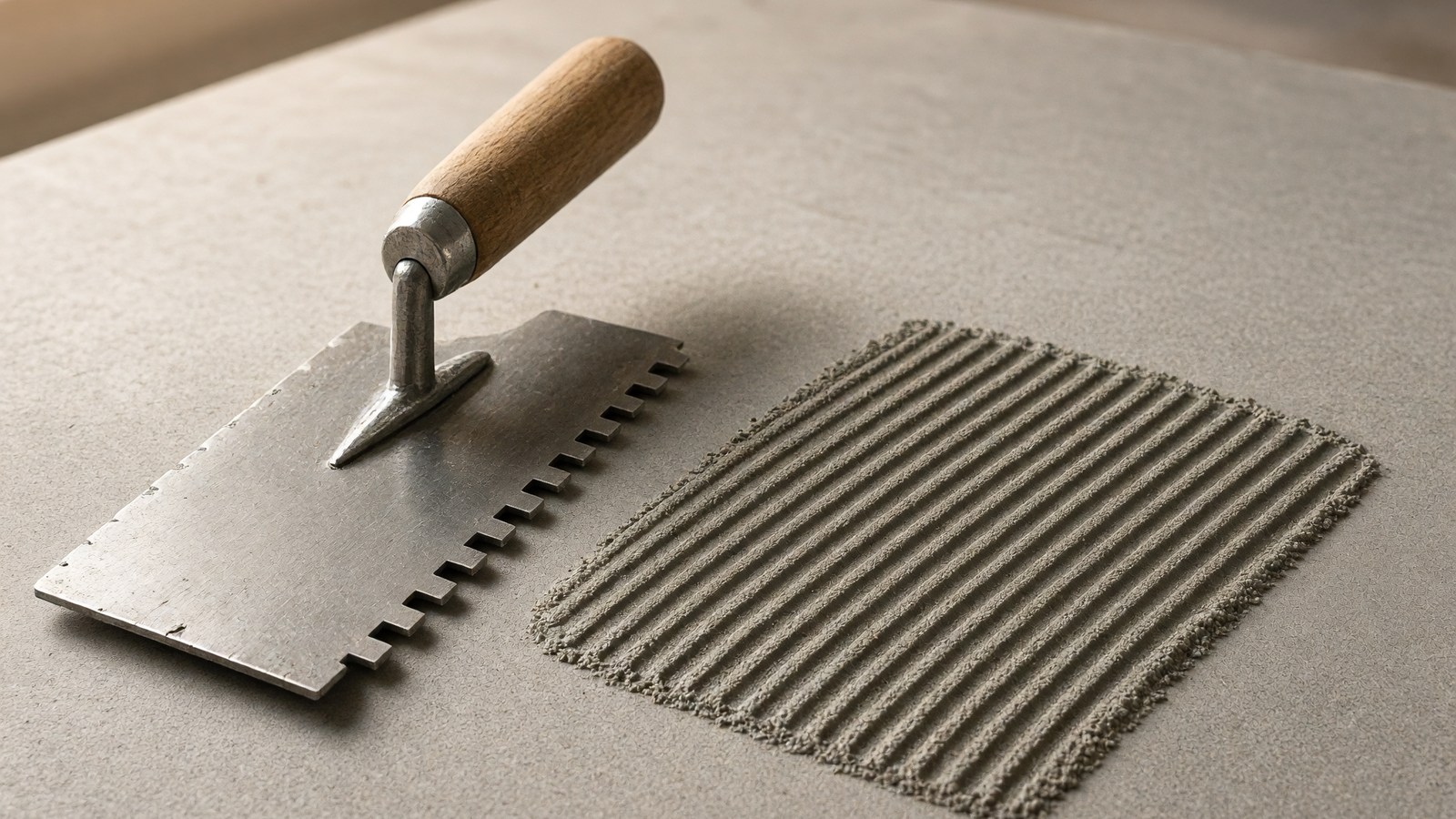
What sets thinset apart is how it is used. TCNA explains that tile set by the thinset method is adhered to the substrate with a thin layer of cement, which it describes as typically not greater than 3/16 inch thick. So when someone says "mortar," they may mean this thin layer, or they may mean a thicker mortar bed. Ask which one your job uses, because the two are different methods.
What does "modified" thinset mean?
Modified thinset has polymers added to it. TCNA says thinset cement to which polymers have been added is commonly called latex-Portland cement mortar, and that the name comes from the latex polymers first used to modify it.
TCNA lists freeze/thaw resistance, improved flexibility and improved adhesion as commonly cited benefits of modification. "Unmodified" thinset has no polymers added. Which type suits your project depends on the tile, the surface and the room, so it is a question for your installer, not a rule of thumb.
TCNA also says the American National Standards Institute (ANSI) defines thinset properties in the A118.1 specification, and sets minimum performance levels for latex-Portland cement mortars in the A118.4, A118.15 and A118.11 specifications. You do not need to memorize these. The useful part is that products are held to published standards, and your installer can tell you which one applies to the product they chose.
100+ Five-Star Reviews
Get a Free Tile Quote
20+ years installing bathroom, kitchen, and custom tile across Chester, Delaware & Montgomery counties, PA.
TCNA discusses mortar and mastic as alternative setting materials. Its general guidance names "mortar or mastic" separately when it tells installers to spread enough adhesive to properly bed the tile. Ask your installer which material they propose and where its manufacturer permits it to be used.
TCNA's guidance does not give one product for every job. It says to use the adhesive recommended for the tile, the type of substrate and the location. That is why we do not name a single winner here. If your installer proposes mastic for part of the job, ask why it suits that tile and that wall or floor, and where the manufacturer says it can be used.
Why does the setting material depend on the tile and the room?
A setting material has to fit three things: the tile, the surface it bonds to, and the conditions in the room. A heavy porcelain floor tile, a small wall tile and a shower wall are not the same job.
Our post on shower waterproofing covers the layers behind tile in a wet area, and the setting material is only one of them. Our kitchen backsplash installation guide makes a similar point from the wall side: not every tile adhesive suits every job, and the wrong choice causes problems.
Coverage matters too. TCNA says big tiles require more adhesive than little ones and that you should get the air out from under the tiles, because voids can let a tile come loose or break. Our post on tile lippage shows how bedding and a flat surface affect how the finished edges look.
Illustration.
Can thinset level an uneven surface?
Not in a thick layer. TCNA says the thinset method is not appropriate for adjusting the level or flatness of a surface. Our post on subfloor preparation says the same from the installer's side: using a thick layer of thin-set mortar to level a floor invites shrinkage and hollow spots.
TCNA adds that because tile set this way is bonded directly to the substrate, any variation or movement in the substrate can affect the tile. A flat, sound surface comes first, and the setting material follows.
What can go wrong with the wrong setting material?
TCNA's page on hollow or loose tile lists causes that involve the setting material:
Poor quality thinset, especially where some shear forces are present.
Poor thinset coverage, thinset applied in "dabs," or thinset used beyond its pot life.
Moisture-sensitive adhesive.
Thinset is not the only cause, and a hollow or loose tile alone does not tell you the reason. If you suspect a problem, our tile repair and restoration guide explains why the surface needs to be assessed before a repair is chosen.
What should you see on a well-run job?
You do not need to watch every step, but a few signs are worth knowing. TCNA's guidance says to use the correct notch-size trowel, which is indicated on the adhesive bag or container. It also says to wait the time indicated on the adhesive container before grouting or walking on the tiles, and that placing tiles on the floor before applying the adhesive, a so-called dry layout, helps.
None of this is a substitute for the manufacturer's instructions, which control how a product is mixed, applied and cured. If you are curious, ask your installer to show you the label for the product they are using. It is a simple way to see that the plan matches the product.
Illustration.
What should you ask your installer?
You do not need to pick the product yourself. Bring these questions to the estimate:
Which setting material will you use for my tile, my surface and this room, and why?
Is it a modified or unmodified thinset, and which standard does it meet?
How will you check that the surface is flat enough before tile goes down?
How will you make sure the tile is fully supported, with no voids, especially for larger tiles?
Where does the manufacturer say this product can and cannot be used?
A good installer will answer plainly, and may show you the product's data sheet. If an answer is vague, that tells you something too.
Frequently asked questions
Is thinset the same as mortar?
Yes. Thinset is a type of mortar. TCNA calls it a blend of cement, very finely graded sand and a water retention compound, and says thinset, thinset mortar, dryset mortar and drybond mortar mean the same thing.
What is modified thinset?
Modified thinset has polymers added to it. TCNA calls it latex-Portland cement mortar and lists freeze/thaw resistance, improved flexibility and improved adhesion as commonly cited benefits.
Can I use mastic instead of thinset?
It depends on the tile, the surface and the room. TCNA says to use the adhesive recommended for the tile, the type of substrate and the location. Ask your installer why they chose the product they did.
Can thinset fix an uneven floor?
No. TCNA says the thinset method is not appropriate for adjusting the level or flatness of a surface. The surface should be made flat before tile is set.
Does the setting material affect how long tile lasts?
It is one factor among several, including the surface, the coverage and how the tile is installed. TCNA lists poor thinset coverage and poor quality thinset among the causes of hollow or loose tile. We do not promise a lifespan for any installation.
Planning a tile project in Chester County or the Main Line
If you want a second opinion on what your installer plans to use under your tile, we can talk it through. Milford Mills Tile serves Chester County, Delaware County, Montgomery County, the Main Line and Northern Delaware. Request a quote or call (484) 883-9948. You can also see our full list of tile services or read about our work in Chester County.